Category: method

  • Next research interests / projects – Jan 2026

    I’ve come to some clarity on how my research into infrastructure in my PhD can be developed next.

    1. Book/project/articles/curatorial research – Changing what infrastructure means. Looking at the infrastructural imaginary and instituting imaginary. (Based especially on e.g., introduction and chapter 3, looking at the institutional and wider societal shift this tells of.) It also looks at infrastructural aesthetics, practice, methodologies. It ends at the point of autopoeisis and ecology in Castoriadis’s work / planetary realism.
    2. Book/project/articles/curatorial research – After infrastructure. This is more to do with explore infrastructural practices and alternatives based on the world after the advent of infrastructural imaginaries, infrastructural vision(s), and so on; it also considers post- and pre-infrastructural practice as an interface with ecology to pick up on the critical potential of autopoeisis and ecology in Castoriadis’s work / planetary realism. (Based on chapters 1,2,4, and so on.)
    3. Impact, KE and primary research – UAOIC / Vis-cog-infra. These projects explore the value, usefulness and application of the above research in the field. R+D and research producing.

    Other projects fit into or cut across these strands.

    • After the infrastructural turn – co-edited collection.
    • Infrastructural aesthetics research cluster.

    All of this works to develop, test and create critical and curatorial methodologies, exploring collective materialities, imaginaries and histories and the future infrastructures we need.
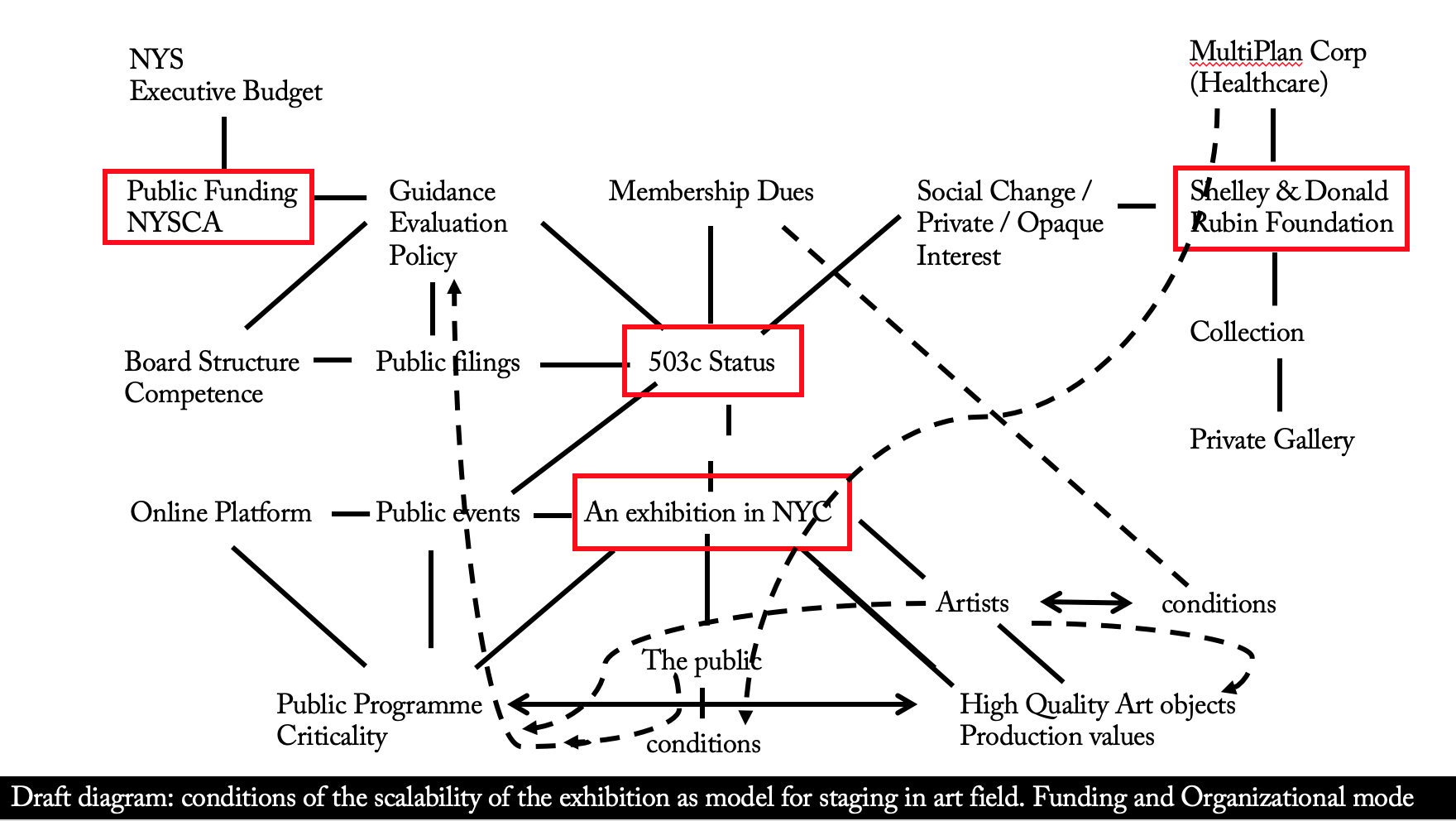
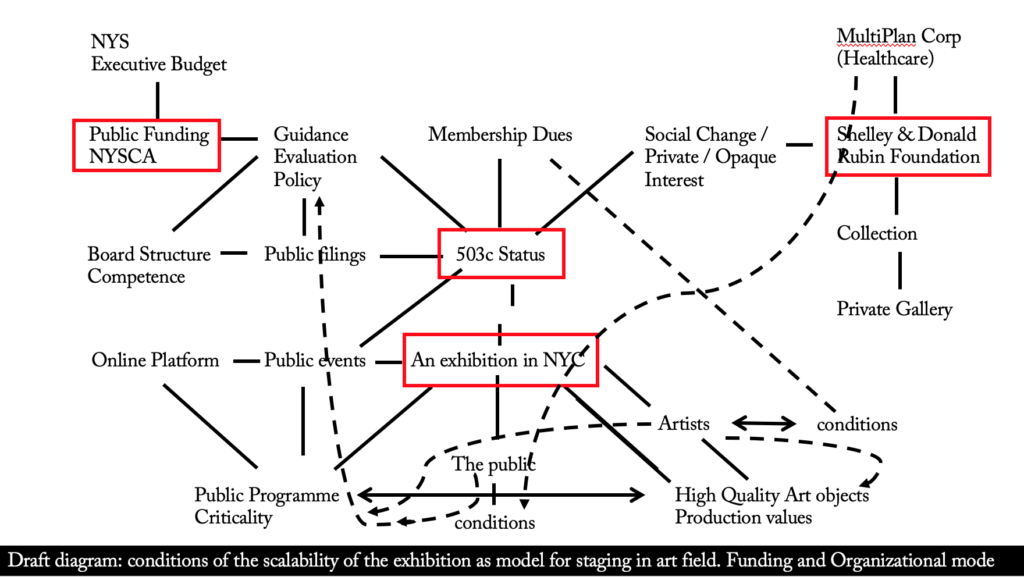
  • Diagrams — draft: the art stack, attempt 1 — 3.

    Diagrams — draft: the art stack, attempt 1 — 3.

    Really basic draft of an art stack, a base layer for a workshop, and centring on the question of conditions for scalability for the exhibition: why it is required to be, and how it is kept in certain scalable forms — and how we might be begin to work on other scales, scalar patterns, and interrelations than those which determine repeatable, scalable forms such as the exhibition and art works. Addressing these questions are central to the ability of art to intervene on infrastructural imaginaries, and assemblages. 

    Required for context:

    – Anna Tsing’s work on scalability: the ability to expand without changing basic elements: https://read.dukeupress.edu/common-knowledge/article-abstract/18/3/505/6827/On-NonscalabilityThe-Living-World-Is-Not-Amenable?redirectedFrom=fulltext

    – https://arts.ny.gov/how-applications-are-evaluated


    (developed while working on a text about Scalability, Infrastructural Speculation and the Scalability project. https://www.airgallery.org/exhibitions/scalability-project-for-information)

  • Diagrams – indicators, levels, methods of close not deep, process – 1. Ngam

    Diagrams – indicators, levels, methods of close not deep, process – 1. Ngam

    In this series of posts I am publishing/sharing some working and research diagrams which are helpful in articulating some key problems and methodological questions when researching infrastructure. While they relate to general questions when studying infrastructure, I am especially interested in how they can be and indeed must be developed for the increasingly complex, systemic infrastructures of staging, publicising, meaning making and mediation as they interpenetrate with the cultural infrastructures of the field of art, design and architecture.

    These problems are familiar, if not fully discussed in the frame described above, and include:

    • The problem of indicators and levels (Star, 1999). Or, how at each level of infrastructural operation or action, a different kind of indicator is necessary, eve if the overall infrastructure is a combination of all these layers. For instance, we can think about infrastructure as an artefact; or as a trace or recording of activities, where the infrastructure is also an information collecting device; or it could be a representation of a / the world. (Star, 1999, 387–388)
    • The need to read with the action of infrastructure, getting close but not deep (Love, 2010) in order to move with and across these levels. As soon as one tries to fix in and read into or interpret an infrastructure as an object, it ceases to be actively infrastructural (a point also made by Easterling, 2016), and we can no longer see what it does, how its through put patterns the world (Berlin, 2016), or its effect as a relation to its process.
    • Understanding and articulating the information and meaning of infrastructure as a process rather than quality, processes inherent to infrastructure, but not mutually exclusive to other forms of meaning (Hayles, 2017), and reflecting on an representing the action and outcomes of these ways of thinking, meaning-making, staging and so on.

    Note: these diagrams are exploratory and primarily concern methodological questions. They are not necessarily to be considered ‘findings.’

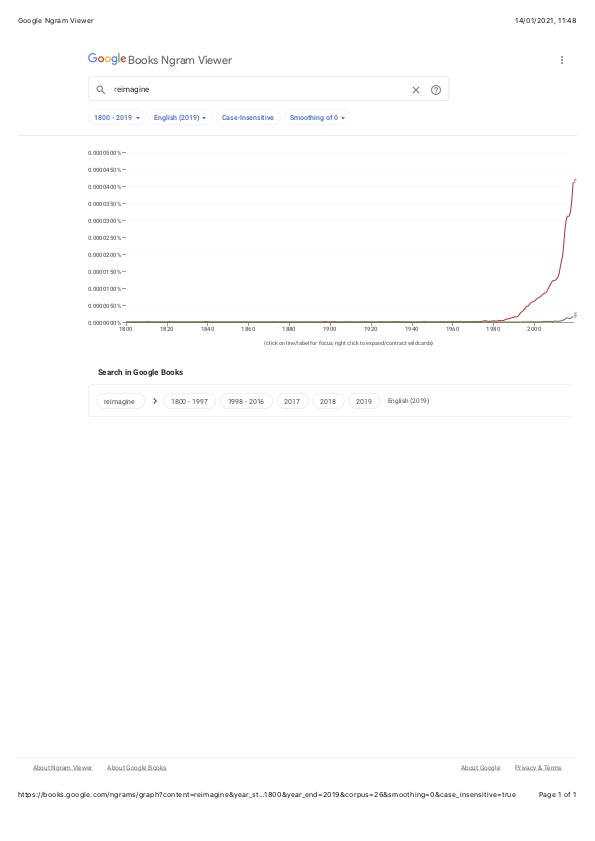
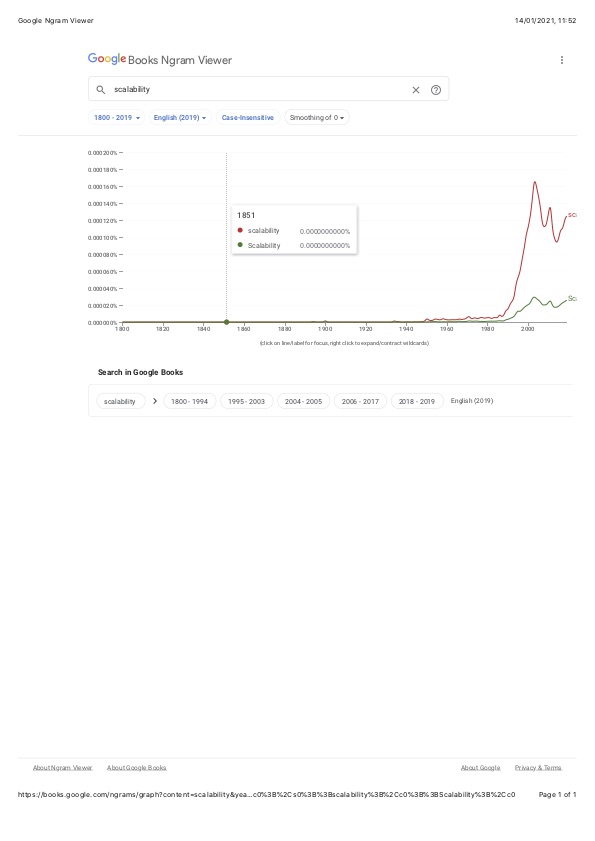
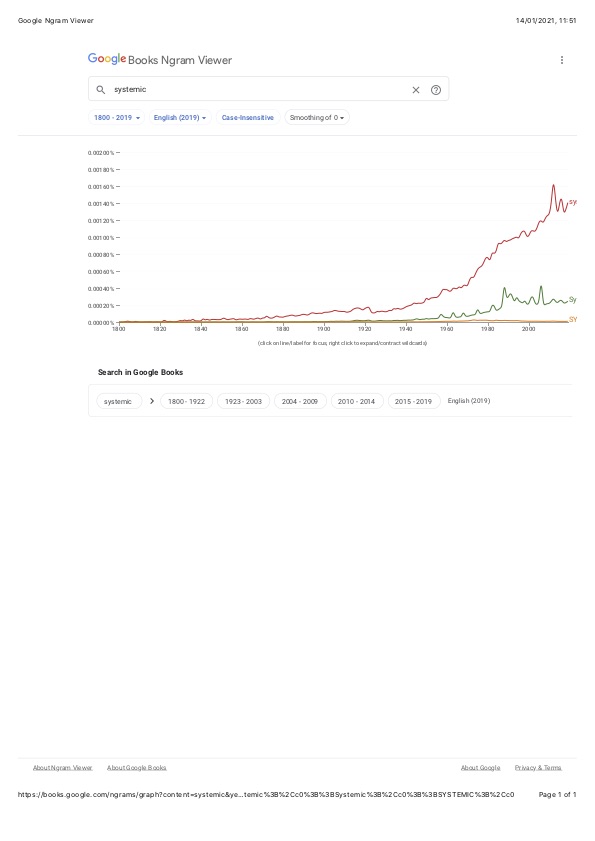
    The first is a series of ngrams using Google (https://books.google.com/ngrams), which measure the frequency of word usage in language corpuses. (I began thinking about this kind of pattern recognition as research method for infrastructure in a workshop series on digital humanities for the arts “Arts and Humanities in the Digital Age”: https://chasedigitalage.wordpress.com.)

    They are certainly research prompts at this stage. A place holder.