Category: instituting

  • Next research interests / projects – Jan 2026

    I’ve come to some clarity on how my research into infrastructure in my PhD can be developed next.

    1. Book/project/articles/curatorial research – Changing what infrastructure means. Looking at the infrastructural imaginary and instituting imaginary. (Based especially on e.g., introduction and chapter 3, looking at the institutional and wider societal shift this tells of.) It also looks at infrastructural aesthetics, practice, methodologies. It ends at the point of autopoeisis and ecology in Castoriadis’s work / planetary realism.
    2. Book/project/articles/curatorial research – After infrastructure. This is more to do with explore infrastructural practices and alternatives based on the world after the advent of infrastructural imaginaries, infrastructural vision(s), and so on; it also considers post- and pre-infrastructural practice as an interface with ecology to pick up on the critical potential of autopoeisis and ecology in Castoriadis’s work / planetary realism. (Based on chapters 1,2,4, and so on.)
    3. Impact, KE and primary research – UAOIC / Vis-cog-infra. These projects explore the value, usefulness and application of the above research in the field. R+D and research producing.

    Other projects fit into or cut across these strands.

    • After the infrastructural turn – co-edited collection.
    • Infrastructural aesthetics research cluster.

    All of this works to develop, test and create critical and curatorial methodologies, exploring collective materialities, imaginaries and histories and the future infrastructures we need.

  • Information war

    Information war

    A quick post which will be more topical than usual, but which is relevant to the overall drift of this blog. Specifically, it is on the current ‘scandal’ surrounding the BBC Panorama edit of Donald Trump’s Jan 6th speech, which conflated two parts of the speech from 50 minutes apart. Of course, in creating the impression that Trump was more direct in calling for violence at the Capitol than was actually implied, a grave and stupid editorial errors was made. This is an especially serious mistake for the BBC which is built on an in reality extremely difficult to actually achieve ideal of impartiality. More so, for the now departed Director General Tim Davie, who had staked his tenure at the top of the BBC on achieving an impeccable reputation on bias —  or the lack of it.

    I remember thinking that at the time Davie made this his mission, it was a both laudable aim — we need this kind of reporting-based fact-centred aspiration in a time of such media polarisation and information medation — and fool-hardy. Bias in an age of information war — which after all is what we are now in — is both weapon and its fatal consequence. Bias is a weapon to use against the other side and how they present ‘their’ information; and to be accused of bias is to have ones information rendered false, untrue, untreatable. In the current media environment, any connection to verifiable, testable reality is irrelevant to the context, positionally, power of the address or interlocutor.

    We are, to be clear, in a war over who gets to say what, who gets to authorise the boundaries of speech, and crucially, its consequences, or lack of them: social. legal, institutional, cultural and so on. (For instance, the argument over free speech is in fact over the claim to be free from social/legal consequences of speech, especially exclusionary speech. This right is codified formally in institutions and informally in social codes — thus, speech and its consequences, is part of how a society is instituted.)

    And this brings me back to the connection between this story and the themes of this blog: that institutional aspirations and even possibilities, such as those of the BBC and of a source of truth, are under serious threat and transformation through the massive infrastructuralisation of information, mediation, social-interaction via the tech industry and its grip on social media as the cultural platform of the early C21st. That is, we are in an information war not only concerned with what is said or seen, but how it is validated, authorised, and made public. It is a war the right of politics, and the new-conservatives, are winning in part because they are the only ones (with some exceptions, Novara e.g.,) fighting and more importantly, infrastructuring and instituting. The BBC and those who believe in its model of the truth continue to operate a sense of the truth based on a model of the civic sphere based on the nation, the academy, the civil service and judiciary, international law, and so on — the post-war social contract. They continue to hold to institutions as though the aforementioned complex continues as the infrastructure of information and knowledge distribution and mediation. While this may still be in existence, and may still be operable, and may be reformable; another, much more impactful infrastructural layer has been built on top, and literally in the way of this complex. That is, the tech-new right information infrastructure-assemblage of social media, blog/podcast/vlog influencer-ecosystem, always there smart phone interfaces and the cloud/logistics/service/enterprise/data industries on which power and resources are built and enclosed which provide the container and source of wealth, power, proximity to politics on which the new right is consolidating its world view as the world.

    Those not on the side of the tech-right are simply not fighting this battle — seeing only its surface, the so-called culture war — as its only terrain and only about symbolic/representational questions. (This is somewhat unfair, as the debasement of climate politics, DEI and Critical Race Theory shows: there are real structural fights going on, which is why these initiatives needed to be killed off.) Arguments around the BBC are had on the surface, on the possibility, or specific failures of impartiality; not on how to establish a truth or authority within the context of an information war such as those initiated by the new online right.

    I went to bed last night confused about the resignation of Davie. I woke up listening to the radio, angry at the ceding of ground to those who are precisely aligned against democratic ideals of civil society (issues of BBC’s actual impartiality notwithstanding), in place of the the tech/gnostic/model of neo-conservatist, extractive nativism and atomisation.
    The issue is on the one hand that the right want to reduce access to to information and its social context / use – ie civil society, and on the other of the control of narrative, information, knowledge and power. This is achieved precisely by disarticulating old institutions and infrastructuring new realities through the wreckage. This is what enables the re-centring of the institutions of neo-feudal power, money and ‘knowledge.’
    (opening image source – https://reutersinstitute.politics.ox.ac.uk/news/bbc-under-scrutiny-heres-what-research-tells-about-its-role-uk)
  • Residency post 1 – Harraway – Funny Stories

    Residency post 1 – Harraway – Funny Stories

    This is the first post written while on Residency at Rupert in Lithuania, June 2024. Hopefully, this can be a space for the thinking that happens, but which is outside of the specific things I want to try and get done / written. They can be read as thoughts in formation or as notes towards later texts.

    Perhaps to my own shame, I hadn’t known how funny Donna Harraway is. Last night, I went to a screening of Fabrizio Terranova’s 2016 film-length interview, DONNA HARAWAY: STORY TELLING FOR EARTHLY SURVIVAL at Alt Labs / Sodas 2123 in Vilnius, Lithuania. The film began with Harraway describing at once absurd and mesmerising links and entanglements which, though of a piece with her wider conceptual frameworks of kinship and entanglement, also devolved into the hysterics, the excitement and potential of it all. Of escaping the confines of human-centred epistemologies, ontologies or organisational story. And with this, more specifically, this is those which delimit and confine certain ‘kinds’ or appearances of human as apart from and better than so-called nature, matter, etc.  It was a warmth I hadn’t expected — perhaps foolishly given the rigorously freewheeling nature of her written work — but which created and enacted the conditions for one of Harraway’s central contributions: kinship. I was on board. (The film was made with a friend, a relationship Harraway later cites as being centrally important to her development / thinking / commitments.)

    This warmth also leads a path to the other key themes of the film and Harrway’s work: story telling. Recounting another origin story, Harraway describes a family background and upbringing steeped in story telling and Catholicism. Again, a story steeped in laughter, Harraway talks about the importance and depth of storytelling that is foundational to her upbringing, sitting around the dinner table with her biological family each competing of the best story. Her father, she notes, was sports journalist for The Denver Post. He was not swayed by the glamour or prestige attached to ‘more serious’ topics like crime or business reporting, but wanted to tell ‘the story of the game’. I liked this a lot. That ‘everyday’, collective practices or intensities, or rituals of sport could be the source of so much detail, interest, difference and drama that it would be worth telling and recalling. That one could dedicate a life to its telling, to communicating that intensity, locality and communal narrative. It also helped to ground some of what Harraway would later discuss about the importance of a practice of positively making new things; of telling the specific knots, differences, attachments of this story, of the specific as the site where the general became unstuck and where the specificity of an other wise — ‘it’ — might be found.

    Then, with another bout of perhaps more nervous laughter, she also acknowledges the problems, the power dynamics, the exclusionary, destructive aspects of this story of fascist-adjacent American Catholicism as well as her sometimes messianic attempts to lead the local children on religious missions — using this productively, or at least generatively, to offer an important framing for the role of storytelling and the kinds of kinship that can and must be built. That of inheritance.

    How and why do these things become relevant and come together?

    The artefact of film itself offers something of the texture and implications of Harraway’s work. Difficult to tell at first, but Harraway, who is talking to Terranova off camera, is filmed against a green screen and superimposed against footage of her house and office. The backdrop begins to pan disorientingly with Harraway appearing, doubled and at work in the background, or else with jellyfish floating behind or the room switching location at will or dropping out of shot. These parallel or simultaneous realities are heightened by archival footage of Harraway, her friends, or tongue in cheek TV lectures, or science fiction imagery collaged into the centre of the frame. Of course, you might say: these quasi-structuralist, post modern techniques of film making are of a piece with the digital era of hyper-situated, circulatory and disoriented story telling that often characterise contemporary visually-speculative narrative modes. (Indeed, the film’s director co-runs a masters in speculative and experimental story telling at Brussels’ ERG – School of Graphic Research.) Alongside this, through, the interview contained, for me, some key ideas and questions about what story telling might do in and to the world, and how.

    Stories and kinship

    I enter this having an interest in the ways that narrative can in the words of Meike Bal act as a motor or assembling device in a story (1999). For me, this can helpfully transposed to the repeating anticipatory narratives and practices of cause and effect that make up and hold together infrastructure; an infrastructure (and its transformation) is nothing without an animating story, purpose, outcome. That is, stories hold an infrastructural world up and keep it practically bound to itself (Rossiter 2017). Narrative can be an effective analytic and expository device when considering the often difficult to ascertain totality of infrastructure.  It is especially used by environmental humanities and STS to convey the integration and significance of parts and constituents of active assemblages and the ways that they are situated and relevant (see Star 1999, Bowker 1994, Green (2020). It can also be a means of breaking and making other ways of being and doing together, at meso-scales since stories are one way that the anticipatory meaning and practices that allow infrastructure to be understood to show up as and where expected (Thrift 2004) become expected, relied upon (Berlant 2001). That is, narrative is one way in which the form that comprises infrastructure circulates to become a genre (Berlant), becomes habituated or relied upon (e.g., the ‘democratisation’ of information is how online platforms are woven deeply into everyday life becoming effective surveillance machines). The task, as is echoed/clarified by Harraway here, is to change the kinds of story that hold things together and what, and how and what can circulate so that how a world repeats or endures is different too. (On a damaged planet this is ever more important.) So what did Harraway say about stories?

    To begin with, stories are key for Harraway to the possibility of other ways of being, for intensities to be felt, communicated, known and modelled; for them to become ritualised and to support collective being. She gives the instance of marriage, which though not at all suitable to the forms of kinship and family she lived and wanted, were all they had. They did a job, but were at the same time limited / limiting. This lead in Harraway’s story and work to a desire and commitment to find, tell, create other kinds of story; or redistribute the narrative (Harraway 1986). Towards the end of the film, Harraway narrates a sci-fi inflected story of another kind of kinship and biological entanglement: parenting is not limited to reproductive parents and at birth one is given a cross-species kin, or symbiont with which one will live and inhabit the world with. In this telling, the character lives in symbiosis with a monarch butterfly. While pronounced female at birth, the character decides she wants a beard. Because, in this story, the character lives with a symbiont, she chooses that this beard be of Monarch butterfly antennae rather than hair. A radically different story of what a family or kinship is, does and how it mediates relationships to the world, developing such shared, cross-species intensities are part of how Harraway instantiates the conditions of a wider project of imagining and exploring real and speculative non-extractive ways of doing and undoing. Of living on a damaged planet in ways that demand and enable other kinds of negotiation.

    In contrast with this — or maybe towards this — she also discusses the dangers of stories becoming universal; of the power vested and invested in keep those stories universal or generally-applicable. Capitalism, capitalocene are discussed; their absurdity and violence is in their status as the only way of telling the story of human-earthly life — for those invested in it and those whose critique of it excludes any other way of thinking. (We need marxism/ists, but other ways of knowing too.) This occurs for critical terms too. Chulthocene, Anthropocene, are useful and limited, and in the case of the former a bit of a joke. They do the job, yet they risk becoming total, their difference becoming meaningless. The importance of this non-generallisablity is that it is allows for and is situated within the ways of being, doing, communing that are not repeated to the extent of becoming self-same, exclusionary, against alterity, entirely synthetic to a world of otherness. Rather, this specificity requires an ongoing negotiability; and a connected, recognition that in a dynamic, interconnected, and processual world of systemic and ecological interaction and niches, doing must also be about undoing. About living in the compost. (Here, to stay with the trouble is to stay with these edges: where the exclusion happens, but also the site where negotiation must — echoing Tsing’s concept of non-scalability.)

    Ways of doing and undoing

    So, while stories offer a conceptual frame for how ways of doing and being are known and held together, they also indicate or reveal the significance or consequence of the specificity those stories, particularly as they attach to objects or others and despite the tendency of some stories to become a generalisation. Why? The concept and actuality of inheritance, for instance, shows for Harraway the consequence of stories of and as ways of doing as they clash, negotiate, come into contact with others. Holding a Navaho woven basket she, as a white, American woman, inherits a brutal history of genocide on the indigenous American populations that means she must reflect on what it means to hold that basket in her hands. She inherits the story and impact of Catholicism in this place in this sense too. But turning to her dog, who is experiencing the onset of dementia and whose barks for comfort interrupt the filming, she also inherits a history of species companionship that allows her to comfort her dog, to make good on a relationship.

    Between these specific instances, we find the tensions that can be set up in how stories and how we inherit them. That is, as ways of knowing and doing attach us destructively, generatively, abrasively, etc., into communities of others, and what might be called worldings — where such stories are generalised and enforced as the parameters and limits of shared or proximate existence. On the one hand, she holds and possesses an on object whose cosmology is dramatically at odds with the stories of conquest she inherits; on the other is a story of shared intensity of experiences whose inherited features (companionship, mutual training and responsiveness) cannot be fully known or defined and which generate ongoing mutual dependence. This tension is, then, posed in a non-reparative sense (Berlant, 2016), as a call to be attentive to and to tell and create moments or stories of specific attachment and entanglement. Not as representation in general, but as a part of a commitment to alternative ways of living. To living with the inheritance of a damaged planet which must be negotiated ongoingly as a reality and as a strategy of flourishing with it. This is a serious commitment.

    Family-making and telling is, for instance, such a commitment. To be with, to support, to care for and to be cared for is a lifetime commitment and a serious one: especially when that family and kin are outside of the reproductive family, social norms, or species kinship, such as Harraway’s. It requires, rituals for those ways of being and of dying. This commitment to making and unmaking, telling and retelling, knowing and unknowing of rituals or ways of attachment and doing / undoing is both provided for and key to the metaphor and actuality of what Harraway calls living in the compost  / staying with the trouble. That is, at once it negotiates and embroils us in the ways we must make as well as share and use the resources of a much wider ecosystem or assemblage of beings and needs; and that this pivoting towards both a wider net and a balance between giving and taking is the only way we can live, indeed maybe flourish, on a planet so damaged by extraction and capitalism.

    These terms, of analysis and of a generative philosophy of a good life inspired by and out of this situation clarify and are clarified by the method or practices that it emerges from and what can be taken from it. Specifically, I am thinking of on the one hand the biography of Harraway and these ideas; she tells of building a house, garden and family whilst writing — and of writing only in the summer because teaching take the best of you. These activities, grounding and reflective, creative and iterative are key to understanding how other ways of doing and undoing might be realised. That is, through thinking and making; and making in order to give thinking life in its having to negotiate the assemblage it becomes a part of and which one must make ideas into. And on the other, a more generally-applicable lesson for the relationship of theory / practice proposed and articulated  here together; we need a direction of travel / analysis & iteration that instantiates critical positions / propositions, and a positive, creative act which activate and which mediate / modulate the possibilities that theory / ideas imagine. What might be reality is made out of concrete contact with what already is. This changes what has been, and is the only way that something else might be. The last words to Harraway:

    And yet the only the way to come into grips, to come into presence of it, … is to constantly keep doing positive things; you have to keep trying to make an experiment work. You have to keep writing this particular story, not some story in general, but this story. You have to do this. Be here, not everywhere. You have to be attached to some things, not everything. The only possible way is if again and again and again if we engage each other in doing something [laughs].

    Watch:

    Donna Haraway : Story Telling for Earthly Survival / Trailer / Fabrizio Terranova / 2016 from Atelier Graphoui on Vimeo.

    Thus, this story is of how to create difference; to get to groups with it — that is, what is not the abstraction, but what is real, the trouble, the compost — the possibility of living outside the generalisation. The uncertainty of not being able to give or allocate a name to something offers the possibility of new meaning or practice. This requires the thinking of at least two temporalities or trajectories: the reflective and compositional and the grounded and mattered; or, to adapt Cornelius Castoriadis (as I did in my PhD), to imagine and institute, with the productive tension between them the stakes and what is at stake. Between these dimensions of story telling — narrative and the telling; repetition and inheritance —  is where the negotiation and being with happens, that is, the ongoing negotiated co-existence necessary to living and flourishing with others. Important now more than ever.

    For me, some open questions remain as to how this fares when in contact with structures for shared, common existence, however.

    Infrastructural imaginaries (to redistribute the narrative)

    A main question is one reflecting on the particularity of infrastructure, as that which must be known — or narrated — in advance if it is to be recognised as coherently infrastructural. Admittedly, Harraway is not discussing infrastructure here; however, the centrality of narrative to infrastructure, and of ways of doing and undoing Harraway discusses to how we might think about infrastructure means I can ask this question of the relevance of these ideas of story as they attach to, interface with, negotiate the category of things and practices that are infrastructural and, indeed, which must be also changed if the bigger project Harraway poses of living well is to be realised.

    Specifically, this is the question of how to realise and sustain the conditions for these other kinds of life in dimensions outside of the personal or individual, familial or domestic (in its baggiest sense). This is not a difference in kind per se ‚— i.e., stories and inheritance play similar roles to those of anticipation and expectation of infrastructure — though the difference in scale, temporality, composition or location in infrastructures emphasise the question of distributing agency outside of the human story teller (which is nonetheless central to Harraway’s story here) more acute. That is, to reflect on the structuring dimensions of inheritance as the means of sharing that way of doing and undoing. And to be yet more specific, I am referring to how narrative or story-telling might, in a creative, positive sense might interact critically with the temporality of the loop of infrastructure. Both looping in advance of its realisation and as its reality (see PhD). In many ways, this is academic. Story telling enacts its own infrastructures of possibility through the device of narrative (Bal). But how this relates to or relays with both the practices and epistemologies this enables (Harraway) and the systemic arrangements, work (Carse / Bowker) and how these negotiations are ongoigingly negotiable/negotiated (Carse / Verran) and Configurable (Suchman) remains key to the durablity of these propositions as liveable and sustainable in a planetary sense.

    The setting of creation and instituting

    Another question is of the locus or agent of story telling and doing in Harraway’s work — at least as articulated in this film. (More work is to be done on checking this, of course.) For instance, the stories told here are ones of individuals interacting and deciding on how to live. For instance, choosing to model ones own body with Monarch antennae; the playfulness in kin making through symbiont from birth. The units are small and so there is a tension with the larger scales of relationship / relation that is some how un-addressed. Perhaps intentionally; but not sufficiently for my project. Here, then, I depart from Harraway’s approach, which like a lot of North American (post-Western) theory departs with an idea that individuals make themselves into a world, rather than a European one which imagines itself into or out of an already extant (and in many cases a priori / fundamental worlding, ontology, epistemology, etc., e.g., language, humanist, rationalist, etc.

    Instead, I depart with the notion or inheritance of infrastructure, or infrastructure-like ways of negotiating being and doing in common as the meso-scalar unit or site for how we create into, know/sense and account for the shared, collective experiences of being in an environment with others. Of course, one could imagine radically non-human ways of being. However, in the same way that non-human organisms and matter creates structures or systems of existence and persistence, infrastructure is what we refer to when we refer to those initiated by humans. (I also blur this definition with institutions, which, like patterns in cognition are where certain kinds of meaning are stabilised, anticipated and recognised.) Infrastructure is thus, like the house or theory or family Harrawyay built(ds), a locus of thinking, support structure and interface with others /other beings / negotiation. As noted above, to centre infrastructure requires that we think about narrative in particular ways. This does not contest Harraway’s ideas discussed here, however. Rather, I think it offers a complimentary discussion of how we might address ideas of scale, scope, sustainability, or stability of such stories / ways of doing, whilst being attentive to the closure / generalisation that is an inherent risk in infrastructure. That is how to infrastructure with the trouble; to compost, do and undo infrastructure and the stories that tell it / it tells; to unbuild it as Halberstam might argue.


    Redistributing the narrative.

    To be imagined by infrastructure / imagine infrastructure is a way then of framing another aspect of how and why to redistribute the narrative; the purpose and location of other kinds of story telling. Do we need to address those ways of being imagined by infrastructure: post-truth, more than human sensing, knowing and the artefacts of the Anthropocene? To some extent, to know and think about where we are remains importnat; but Harraway’s project also provokes or is centred by the more foundational problem of sustaining shared life, and doing this well. The question then might be, do these complexities or their analysis support that foundational problem? Do we need to know about these in order to undo or unbuild them? Perhaps in order to unmake the cultural conditions or socio-technical  in which they are genre or at least plausible as such.

    Why as these questions? Because to sustain new ways of doing and undoing requires new kinds of narrative, character, story to be not only told and retold, but to be anticipated, expected, repeated as a ground on which that doing and undoing can endure. A non-sovereign relationality or proxemics made possible (Berlant 2016) in the ways stories allow for other kinds of orientation (Ahmed) to be sensed, known in those ways of doing and undoing; one which allows for the decomposition of that inheritance.

    Perhaps this is exactly the role of the curatorial, to enable, support, imagine, assemblage the cultural, socio-technical performativity or rituals that will make other kinds of land use, kinship imagined, imaginable and institutable; and, following this, durable, sustainable and yet transformable. (Here Castoriadis’ turn to ecology and autopoeisis is interesting.)

    This text is longer than expected. But clarifies and helps to weave a number of threads that I have been considering. Specifically as to the point and articulation of a practice that crosses academic, curatorial and writing/creative practice; of the relationship between infrastructures to cultural / more than human settings, and the kinds of conceptual / performative devices through which these are known, sensed, repeated and inherited, such as narrative and configuration.

    Thanks must be given to my host organisation as this research and time has been supported by Rupert.

    x

    12-6-2024

  • Diagrams — draft: the art stack, attempt 1 — 3.

    Diagrams — draft: the art stack, attempt 1 — 3.

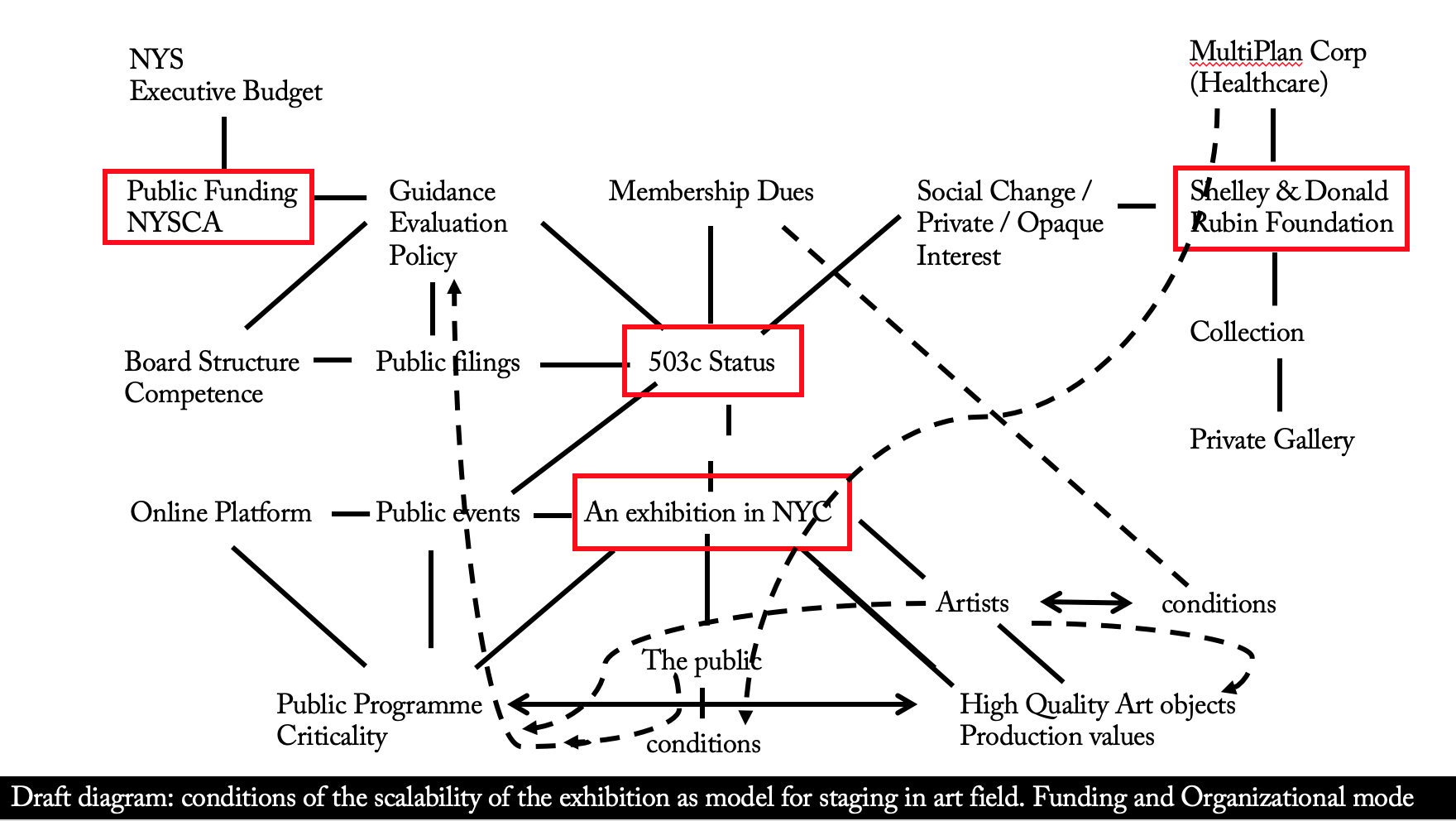
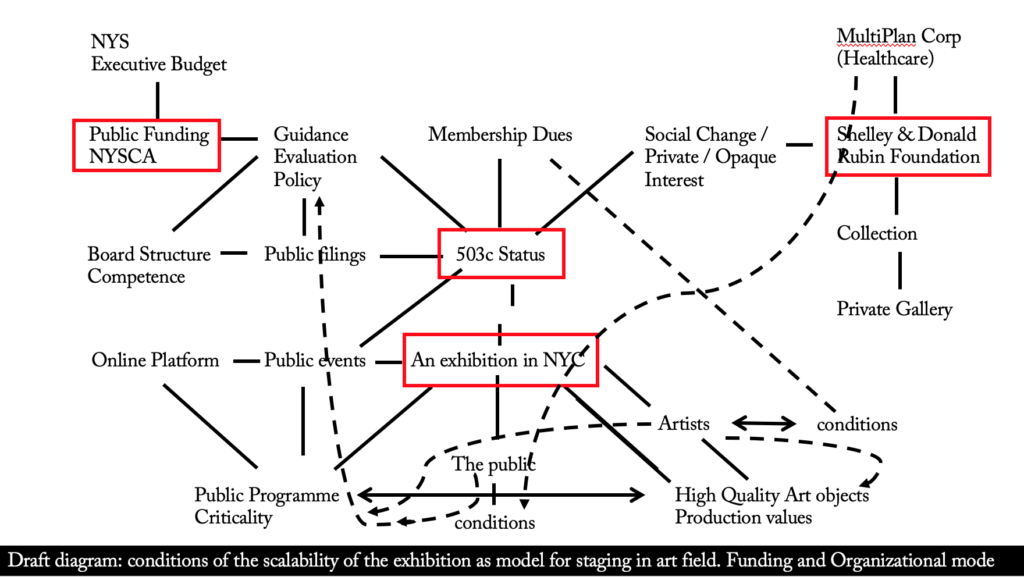
    Really basic draft of an art stack, a base layer for a workshop, and centring on the question of conditions for scalability for the exhibition: why it is required to be, and how it is kept in certain scalable forms — and how we might be begin to work on other scales, scalar patterns, and interrelations than those which determine repeatable, scalable forms such as the exhibition and art works. Addressing these questions are central to the ability of art to intervene on infrastructural imaginaries, and assemblages. 

    Required for context:

    – Anna Tsing’s work on scalability: the ability to expand without changing basic elements: https://read.dukeupress.edu/common-knowledge/article-abstract/18/3/505/6827/On-NonscalabilityThe-Living-World-Is-Not-Amenable?redirectedFrom=fulltext

    – https://arts.ny.gov/how-applications-are-evaluated


    (developed while working on a text about Scalability, Infrastructural Speculation and the Scalability project. https://www.airgallery.org/exhibitions/scalability-project-for-information)

  • Diagrams – moving through the pattern, infrastructural performativity – 2. Infrastructure as practice

    Diagrams – moving through the pattern, infrastructural performativity – 2. Infrastructure as practice

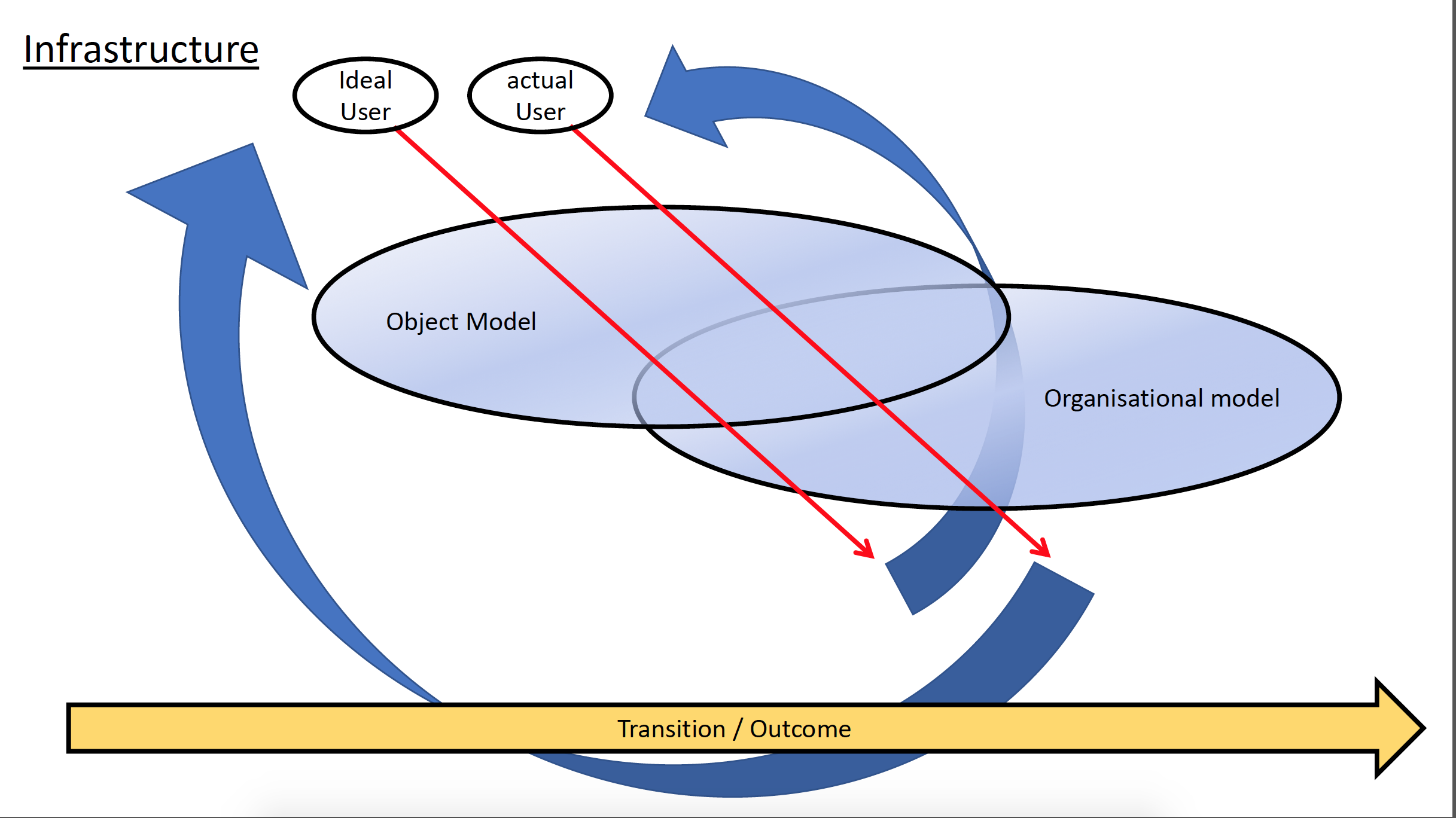
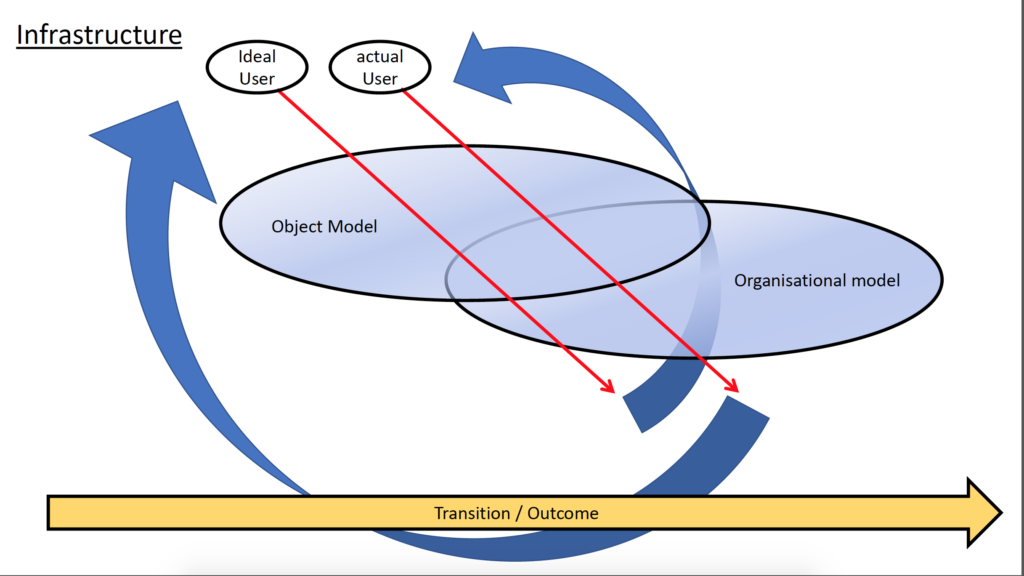
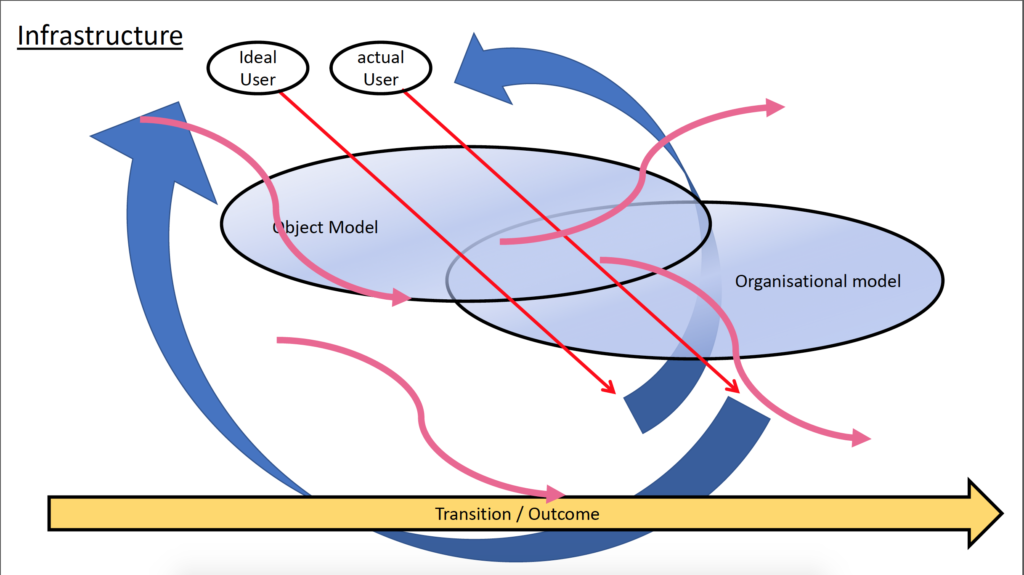
    In this working diagram I attempt to explore how we might model (at a level of great of abstraction) the performative practicing of infrastructure. (It is developed in chapter 2.) This model is a departure from approaches to infrastructure that look to represent or describe anthropological effects, material/media conditions and consturctions for infrastructure, or to assemblages to abstract and describe infrastructure in ways that tie manifestation of infrastructure to specific conditions at the cost of a general model; looking to practice as a means of jointing these fields and opening up the knotty question of what it means to invent infrastructure  (See also Easterling, Bratton, Munoz, Harun Morrison, What can a garden be, New Art Ecologies)

    Infrastructure as practice – Tom Clark. (Originally drafted in conversation with Susannah Haslam in the context of a project for adpe working group: https://artdesignpolicyeducation.art)

    Where infrastructure is an assemblage in form, organisation and operation, so too must the diagramming of how infrastructure is conjured according to expectations about its availability, operation, reliable form, and to whom it is addressable. What is pictured above is an attempt at describing how various parts of infrastructure come together — in myriad ways — to keep infrastructure held together, often against dynamics within or caused by each part. Roughly, it is the performative and temporally, spatially and informationally circular relationship created between the imagined outcome, organisation and transition across the uncertain scale of an infrastructure and the manifestation of each of these factors with that imaginary holding in place that is the basis for infrastructure bing able to exist: since it is circular, where the conditions of existing must continue for certain forms of relational, contextual, information, technological and ecological existence to persist, it is the basis of a repetition that can be either (and most often) standardising, normative and tending towards transition or convention, or (more tricky, and for instance the subject of power relations, such as in ‘disruption’) the basis for invention and difference in repetition. This latter part is explore further below.

    Diagramming infrastructure in this way develops the work of Lauren Berlant (2016; 2001) on infrastructure as pattern and on the circulation of form in order that it become genre, where anticipation and expectation require training before being naturalised as ground. It also pulls on the work of Thrift (2004) who joints the work of Berlant (2001) and Butler (Gender Trouble) to suggest a specific kind of performativity is registered in the particularly relational patterns of infrastructure, as relating to a technological unconsciousness. For Thrift, this technological unconsciousness can be through of as a circular cicurlation of form and expectation, carried out through for instance a sense of addressing and addressability that connects the parts of an infrastructure in how it is used and thought. To transit across an infrastructure we must have an address that we aim for, this address must be knowable to a user, and to the system; hence, to be infrastructural (a system or a user) requires addressability, internally and externally.

    This relationship is represented in the diagram by the cicualtiey between ideal and actual users (but which could also represent use, outcome, process etc.,) as they pass through the organisational and object model (which come together as certain patterns). This addressability can, however, also constrain what is possible in the technological unconsciousness through, for instance, standardisation aimed at making addressing more efficient and predictable. As such, the circular relationship between expecting and enacting infrastructure is performative insofar as this movement through that patterning is both anticipatory and enacts what is anticipated: other wise the organisational work of infrastructure (Geoffry in Carse), would collapse. The provisional unity of infrastructure (Berlant) would not hold and infrastructure would cease to offer a transition across the meso-scale, spatially, temporally, or informationally. It would in Star’s terms be fully contradictory with its intentions, rather than simply invested with desire, master narrative and embedded practices that seems to contradict the hopes of infrastructural designers, and therefore through which this performativity takes place (1999).

    It is this performative, or at least circular relationship that enacts infrastructure that is often most difficult to describe in the conventional models in the humanities and arts, since by relying on cause and effect, instrumentality, relationality, assemblage and pattern, it precludes the kinds of agency on which analytical concepts of invention and critique are built. Nonetheless, by grounding the relational modelling of infrastructure — often diagrammed in Deleuzean assemblage, or measured in cognitive science (Hayles, 2017) — in the specificity of form, event, or image as offered in the arts and humanities, we can begin to pin point this relational model (as for instance pattern), to differentiate it, and to invent it.

    Finally then, the user, or the movement through pattern offers a variable which animates, traces, and potentially disrupts the patterning of infrastructure. Wright (2013), Bratton (2015), Rossiter (2017) and Chun (2011) have focused on the user as a point at which the rules (or repeating conditions and contexts) that hold together an infrastructure, suggesting this is both a submissive and potentially disruptive figure. On the one hand the as Rossiter and Chun describe, the user is required to submit to the expectations and rhythms of infrastructure into access it, thereby shaping their experience of reality. On the other however, as Bratton and Wright hint, this places a lot of emphasis on actors who are constituted but these infrastructures (meaningless without it) and who constitute these infrastructures; as such there is scope for Bratton and Wright to mis use and remodel this use — if we are willing to engage in the relational, instrumental terms of infrastructure seriously and comittedly.

    Brought together, these factors raise questions on infrastructural agency and forms of disruption, how we might differentiate . Seen in Condorelli, Tsing is a need to contrast outcome, intention, form, shape, normativity. For Condorelli, the normally invisible conceptual, physical and labour infrastructures that scaffold the visibility of art offer an opportunity to highlight and rethink the relationship between the supporter and supported through notions of limited duration, supplementary, being brought up against or into proximity with others (2009). While for Condorelli this is relationality is built on top of an ethical framework built around the dynamics of authorship and participation baked into art critique, and as such is ultimately built around representational model of ethics, Tsing offers a relational comparison between scalability and nonscalability (2012). Built around standardisation of business expansion that allows the unchanging scaling up of a project or activity, regardless of the consequences for the contexts, ecologies, or conditions that scaling up affects, scalability is for Tsing, to be contrasted with forms of nonscalability activity which resist, inhibit, enable and complicate scalability. The difficulty for this model is how to make infrastructure where repetition and transitional scales do not rely on standardisation; how to make difference the internal driver and support of infrastructure. However, by, bringing together this dynamic practicing of infrastructure also here suggests it is the dynamic, meso-transitional combination of these two ideas.

    This leads to a second set of diagrams, where these relationship and movements are more scattered, less repetitive — whether by arrangement of parts, or by bringing into tension, one assemblage (or stack) with another, or by staging other kinds of meaning (imaginary) into these assemblages, or where movement through is itself patterned, imagined or conditioned differently — in order that difference immanent to infrastructure can be both given form and differentiated.

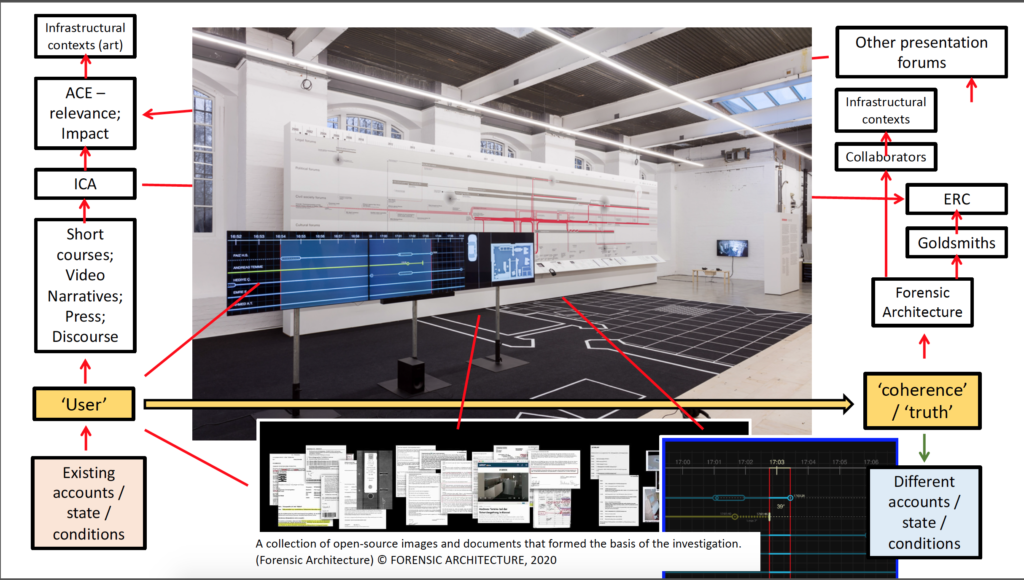
    How would this look in practice? A key example I have explored is the work of Forensic Architecture and its staging in exhibition formats.

    Where exhibition is our frame of reference, the proposal by FA represents a relatively self-contained and reductive model of possibility: a series of reports, timelines, videos and diagrams present a representation of an assertion or claim of truth, based on data extracted and assembled using architectural models.

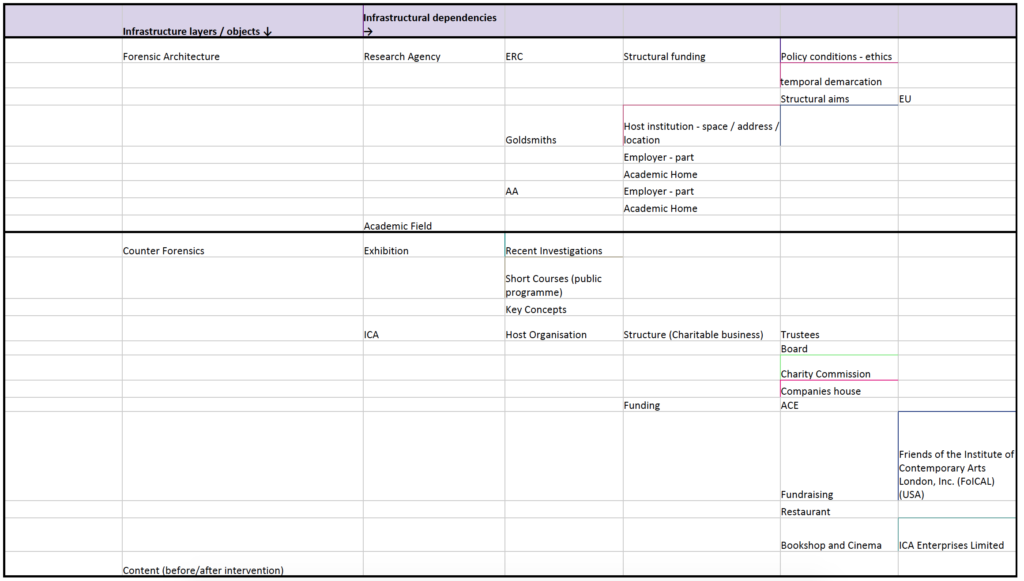
    However, where we view this assemblage as an intervention whose scale and scope extends both beyond the art stack and intervenes in / interoperates with other infrastructures and stacks then the lines of transition and meso-scalar meaning are vastly more complex, and inter/intra-penetrate with multiple other  modes / levels of meaning, staging, and practicing. (simply if we take an intersectional viewer of those coming into contact with it seriously this is the case.) We can begin to see this interrelationship with even a simply diagram of some footed infrastructural inter- / intra-dependencies of the work.

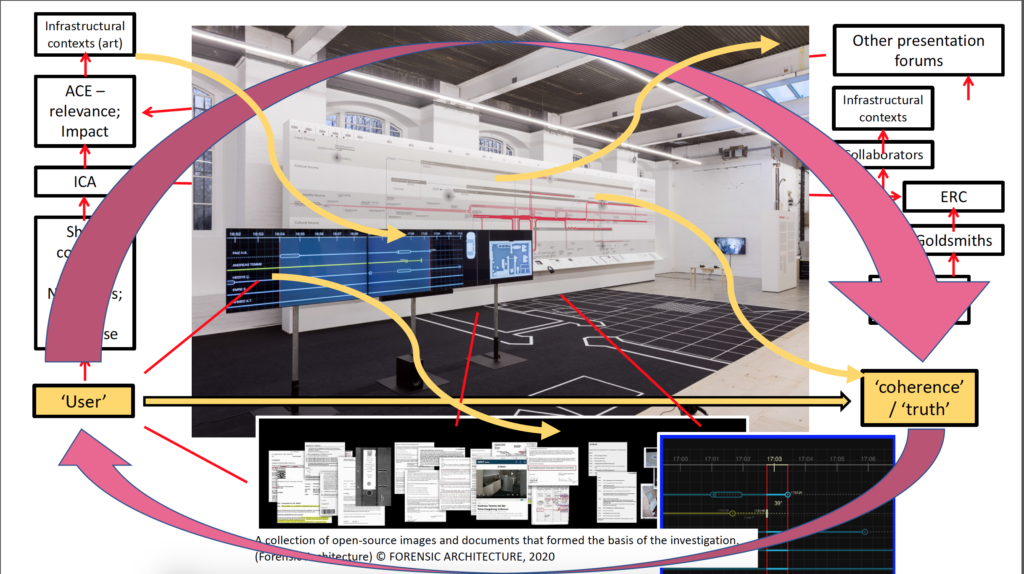
    The question developed in the third chapter is specifically what this difference between representational and relational modes of staging and meaning are, and how, within a framework for infrastructural meaning, critical changes can be made. This will for instance mean the repetition rather than just inclusion of difference as a motivation of change; it will also mean thinking other modes of challenge and visibility to the infrastructural to those used in the critique of institutions: diagrammed below.

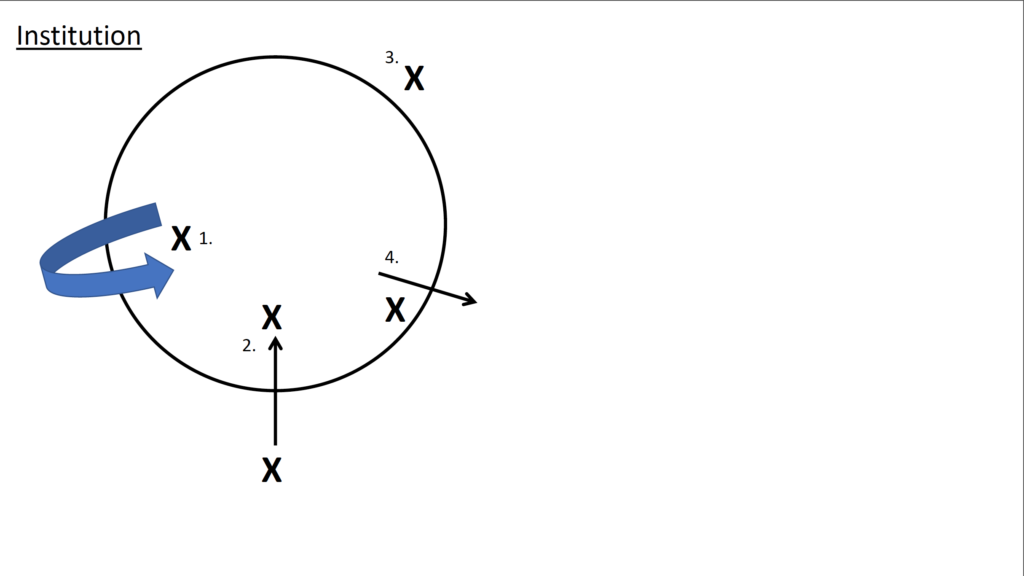
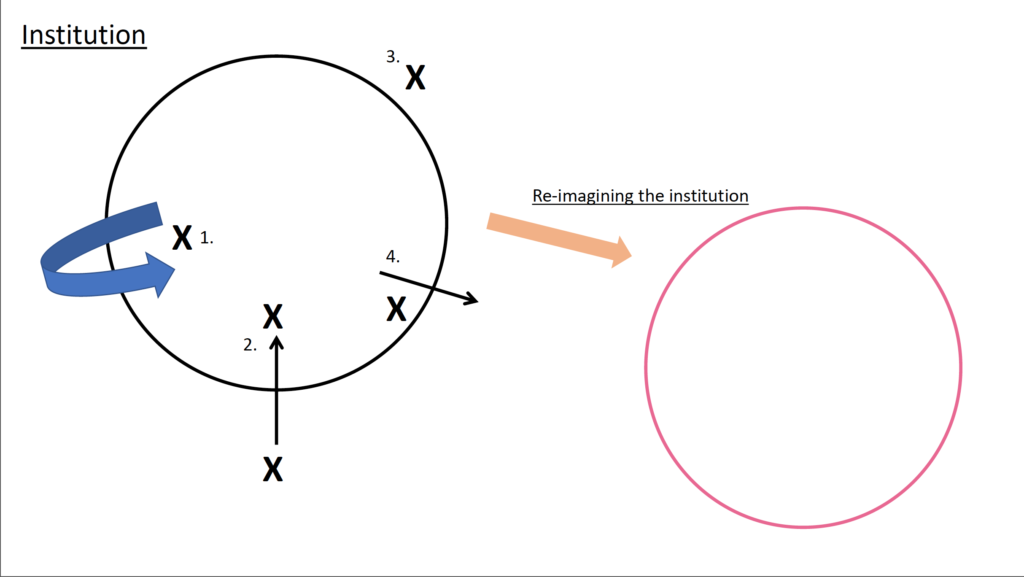
    Classically, institutional critique can be summed up by 1. adjusting the meaning of the institution, where actors already inside seek to remake it via incorporation of an outside; 2. expressing the rub of incorporation into the institution for an actor who was outside; 3. by what or whom it excludes (these latter two are deeply informed by Foucault’s Knowledge and Power); 4. by escaping the institution. This forth approach, which generates it energy from the previous three, is often tied to either a life without institution, or by re-imagining it.

    It is this final movement, of fleeing the institution to live without formalised institution, or to self-institute that I am principally interested in contrasting to an approach to complexification, change, re-making, patterning. etc., of the ‘movement’ or ‘transition’ through the meso-scale of infrastructure as represented by the pink arrows below:

    The difference established for infrastructure will therefore depend on the development of an approach to thinking infrastructure as a practice that is more easily diagrammed as above, than described.


  • Art as a function of infrastructure

    While the overall coda of the research I have undertaken could be framed through the question: how to curate infrastructure (how to understand the fields, actions, operations and interconnections of infrastructure, its promises, aims, worlds and how this interacts with more established question in curating/the curatorial — and how that practice and modes such as the exhibition fit in, or not)? A key, and we might say first order problem is how art can operate as a function of infrastructure: that is technically and aesthetically, symbolically and operationally. These further questions are what will allow a move from those position art as an infrastructure, or infrastructure as a poetics to a critical practicing of infrastructure. These starting positions are useful bridges in an infrastructural turn in the arts and literary studies insofar as they contribute to more nuanced explorations of art’s utility — at least within an infrastructural frame of reference. But relying on an open-ended concept of impact or potentiality as their critical mode and horizon, they fall short of agency because they rely on already-instituted notions of art’s critical autonomy as a space in which to test new categories or identities and reinstitute them, and which are therefore in fact limited by their institutional parameters. If infrastructure can be shown to institute differently to the institution, and as such requires discrete critical manoeuvres to change that instituting, the question I hope to provide an answer for is how art can operate as a function of infrastructure beyond those limits of institutional art; instead within the parameters of infrastructural art.

    This can be achieved with a comparative analysis of case studies in to contemporary conditions and theory and in relation to historical examples which have sought to engage in similar questions of art’s social-material engagement, utility and systemticity, but which saw art as critically unmoored from the infrastructural conditions that prompted them while also dependent on modes of making public such as the exhibition.

    To engage these questions now is in part a reflection of changing attitudes and conditions to how cultural artefacts operate, convey meaning and are operationally meshed in the cultural field and others by changes to infrastructural conditions (advanced technology, austerity), and in part a heightened awareness of the use of infrastructural forms of governance to functionalize cultural and political imaginaries and actors. Art has, like many other fields, turned its attention to these infrastructural conditions. The question is if those practices associated with art have the adequate tools to act on that attention, and what this would enable.

    Refs.

    https://www.academia.edu/29892145/Art_as_Infrastructure?email_work_card=view-paper

    https://journals.sagepub.com/doi/pdf/10.1177/0263775816645989


  • Turner Prize 2019

    Turner Prize 2019

    My feelings on the 2019 Turner prize and the nominees’ (Lawrence Abu Hamdan, Helen Cammock, Oscar Murillo and Tai Shani) request to be recognised collectively move between its challenging of artistic individualism and its acceptance.

    The artists did accept the terms of the prize — both nomination, and now all winning and taking that forward. True, they will split the prize, but they did not jeopardise the possibility that their nomination would not be converted in to the cachet.

    True, they leveraged this position to challenge the terms of the prize, forming an alliance or platform against which the judges could not refuse, and from which to make a claim on the collective and interconnected or ecological nature of the politics they engaged with. And yet, the power of this platform is nonetheless derived from the exceptionality (though combined) of their nominations.

    To view this from an infrastructural perspective: it is by already being in a position of exceptionality, of infrastructural power (as nominees) that the artists are able to assert this collective control over the terms of the condition. They determine the way in which they interoperate with each other and the prize. How can the judges say that no, in fact one winner must be given; this would undermine the selection of any of them — a fact that the assertion of collectivity pointedly underscores and mobilises.

    And yet it is the substance of their claim that comes under pressure from the mobilisation of this privilege. Collectivity of purpose and an interconnecting politic s in the face of social division. To recognise ones position in a matrix, and to assert the possibility of indexing oneself differently within that is an exceptional claim rather than a normative one. For the political claim to be effective — that is to say that solidarity and building a platform for it, is more important than the recognition of the prize, I would suggest, more jeopardy would have been needed for its participants, but only regarding that recognition.

    Ultimately the stake, which the act did gesture towards, is the necessary task of re-infrastructuring the terms in which cultural work affects and produces the world. While individual privilege plays a part in this, and is a position to mobilised, it cannot remain as the heart and centre of claims to the contrary. For this we need an infrastructural politics, a relational ethics, rather than simply an institutional or representational one.

  • Belief in anything – Politics of nothing — The infrastructural void

    Belief in anything – Politics of nothing — The infrastructural void

    What does infrastructure institute? One thing that can be said today is that it is possible to believe in anything, to trust nothing (but what one believes), and that Politics is increasingly seen as impotent in the face of large infrastructural issues (Fake news, social media, Brexit, Climate change, etc.).

    I’d suggest that this has to do with the specifically neoliberal variant of global infrastructural development that has accompanied the post-War and post-colonial period. With its fantasies of “seamless interoperability,” (Rossiter, 2017, xvii) at the conceptual level and — at a structural level — the structural results of the realisation of the “prospect of ‘imperial unity’” (Rossiter, 2017, 155) for the colonial powers who laid the telegraphic foundations of contemporary infrastructure, the infrastructural world materialises an emptied, though incredibly robust, shell through which Politics can also be emptied in favour of brute materiality, management and calculation. Politics as discourse on values, etc., continues, but takes place detached from the material realties of and of life within this shell.

    This “shell” is arguably the substrate for what Will Davies calls “the disenchantment of politics by economics,” (Davies, The Limits of Neoliberalism, 2017, 14) in which economic reason and calculation comes to be the basis of all political, moral and social judgements in the “state (and various other social and political institutions).” (Davies, 2017, 27) This is not say that economics is fully collapsed into all other life, but that neoliberalism constitutes both the infrastructure and corresponding ideological formation of the subject for its economic programme, but that these are not the same thing. To draw on Rossiter, neoliberalism is precisely the management of the relationship between macro and micro scales. “In order to make intelligible the patterns of global neoliberalism, one must attend critically to the peculiarities of subnational scales (the micro dimension) and weigh these against international forces (the macro dimension).” (2006, 27–28) As a colleague of Rossiter’s, Angela Mitropoulos puts it, this should be scaled right down to the intimate, bodily, level. (Mitropoulos, 2012) But to what extent though can we explore how far these material and conceptual conditions of infrastructure extend into the cultural and political imaginary?

    I want to set this in the context of a so-called post-truth, post-trust, cultural environment — which, despite the claims to accountability and transparency that come with economics of calculations — is increasingly used to characterise the current cultural and political moment. To set the scene a bit, just for instance, we can look too:

    The individuation of subjects and evacuation of politics to all but a supporting (economic) infrastructure — which is increasingly, and selectively entangled with platform economics and rationalities (SaaS, UK’s Digital Twin, Alibaba, Social Media as news platforms and so on) — arguably creates the perfect space or vacuum for hyper-polarized, unmediatable disputes, differences, and internal fragmentation. That is, the indifference of infrastructure to the ‘what’ of content — just that it conforms to processing (to adapt Arendt, in Berry, Art and (bare) Life, 2018, 87) — creates the possibility in which infinite user-based or user-group-based realities can be supported and further individuated. Even if these pertain infrastructural conditions, those conditions resist the realisation of a political process, simply because they exceed or disallow them at the level of procedure: either routing around politics or neutralising them (see Rossiter, 2017, 162). The attempts to negotiate political decisions against the procedural, legal, infrastructure of the EU in the Brexit talks are a key example of the foreclosure. (see: https://www.bbc.co.uk/iplayer/episode/m0003xpv/select-committees-exiting-the-eu-committee)

    Of course the vertical power expressed through remaining institutions including the state (Rossiter, 2017, 156), or through vertical infrastructural arrangements (Bratton, The Stack, 2015; Gielen, Institutional Attitudes, 2013), creates pinch points or crossover in this issues. For instance, the aversion to considering social infrastructure within the calculus of economic infrastructure (ONS, 2017, 2018; NIC, 2018), or accounting for or funding it — as with the NHS — is a key point here. However, overall the consequential architecture here, takes shape as a shell, upon which power can sit, and within which, debate and discourse can circulate at a remove, and be managed if necessary.

    Where art might then model small-scale interventions within this void these can easily be accommodated since the institution in general already has a place within ‘the infrastructural.’ More specifically, these interventions can be managed since the infrastructures of art have become increasingly entangled with those of economy. (See Andrea Philips, at Campus Alternative, Nottingham Contemporary, 28 March 2019; Suhail Malik, REALTY STATECRAFT; Victoria Ivanova, “Art’s Values: A Détente, a Grand Plié” (https://www.academia.edu/19727895/Art_s_Values_A_D%C3%A9tente_a_Grand_Pli%C3%A9)) Additionally, we can also say that contemporary art as a genre of indeterminacy (Malik), is itself infrastructural, and thus can be slotted — by virtue of its funding structures/ market dependancy; a compromising of its criticality and autonomy — into the various other infrastructure stacks implied here.

    So as well as addressing the infrastructures through which it passes and is sustained, in order to affect any critique, or to work on the social space of fragmentation that define contemporary cultural infrastructures (post-truth etc.), it would appear that art must deal with the gap between its own infrastructures and those which form this political shell. It cannot however do this on its own institutional terms, and rather must develop an infrastructural practice.

    To begin with I’d suggest that this concerns the creation of interfaces between infrastructures. That is a means by which to pull these infrastructures into one another, to entangle their dependencies and calculations. To again pull on Philips in her questioning of the role of alternative arts education when mainstream education needs support (Campus Alternative, Nottingham Contemporary, 28 March 2019): this would be to embed art as infrastructure into existing infrastructural scenarios, but crucially recognising and accounting for the specific competencies and capacities of the intervention site. In this sense art might be the means of intervention, not replication. To paraphrase Phillips — art or curating shouldn’t pretend it can be an alternative to a field such as education, but should support it in its specific expertise. (Here I am reminded of the work of Pantxo Ramas — see Vessel; And of Lisa Suchmann on configuration)

    The multilayered nature of infrastructure means this focus on interface is crucial at many levels and in many forms — i.e., why hacking the dominant infrastructure (https://frieze.com/article/how-keller-easterling-wants-hack-migration-and-capital-flight; subtext of Metahaven, The Sprawl ) is not sufficient. Instead this production of interfaces should be working towards a multi-dimensional infrastructural redistribution, not least of the relation between models of critique (Boltanski, 2011) into which the small scale model and system-hacks / stack design seem to fall into at a surface level. This also implies the need to institute not just models, but politics of infrastructural critique.

    Lastly this consideration of the interlocking of cultural, social and economic infrastructures, also sets up a timeframe that accounts for the importance of 2008, as a moment where the promise of neoliberal economic infrastructure collapsed into the materialities of social infrastructure, most notably in austerity politics — politics which intervened forcefully on the policies of the cultural industries and creativity-led policies of transformation and participation as was seen in the New Labour years. We can now see the effects of this functionalisation of the social space — if not the infrastructures — in the debates around the Arts Councils’ recent 10 year plan ‘consultation,’ where the term ‘culture’ has replaced art.


  • Indexing, Infrastructure and Social Performativity

    Indexing, Infrastructure and Social Performativity

    For a while now I have been thinking through the question of how one might experience or attempt to perform agency in an infrastructural setting. That is how can we think through a similar negotiation to that of the inside / outside of the institution in infrastructural terms, when infrastructure presents itself as a theoretically total object? (To begin with, this ideal of totality is easily dispelled: either scaling back to include whomever does not get counted as a proper user as far as an infrastructure is concerned (such as the border); or by simply considering the way that infrastructures layer and differentiate themselves and access to their functions, precisely by being layered (see: Bratton, 2015).) One complicated, though temporarily adequate answer might be found in the notion of “indexing.”

    At a more anecdotal level, what I am also trying to point to here is the way in which students I have taught over recent years seem to be less interested in saying “what is,” but rather are engaging in positioning themselves in relation to what they perceive as privilege — theirs or other’s. This is perhaps an internalisation of what Judith Butler describes as the infrastructural politics of vulnerability: that is the ability to negotiate the individual life promised by infrastructure in a neoliberal political order, and the extent to which one is structurally able to actually life independently of one’s dependency on the hard, soft, social and natural infrastructures that support life. (Elon Musk’s escape to space being the prime example.)

    To begin with, it is possible to think indexing in these terms in the following ways:

    • Indexing on a plane / in a field. I.e., where does one stand in a literal, figurative, imaginary, social (etc.) sense?
    • Indexing in relation to, these same things.
    • The index as a measure (see FA post)
    • The index as address (in both senses, of noun and verb) — as an identity and identification: making it possible to be addressed, but also speaking in advance to what can be addressed, politically as much as actually. (This is political insofar as it is both ascribed to a subject, and can be defined by a subject — both as an object and in relation to others. The illegalized migrant is indexed as such; the self-assigned member of an assembly or group defined through difference is another.) It is also a making sense of ones position in relation to not just institution as categorical site, but to infrastructure as spatio-temporal location.
    • The index as a complication of the notion of category. Google’s early tagline: “Search Don’t Sort,” is indicative of this sublimation of the category as container of informational characteristics into categories of objective characteristics — i.e. what can be done with it (can it be searched, indexed, etc.; is it an image, website and so on; one could also think about the way the memory of information itself is treated as a function of how to search it rather than the ability to recall it). This means not so much fitting into a category, but by placing oneself in relation to the category as meta-definition. This act could be mapped against the agency one might have to place or identify oneself on the one hand, or on the other, as Ramon Amaro has so well described, by being identified by others and other systems of averaging and deviation from the norm / pattern (which can be socially as much as mathematically determined, as with the notion of ‘work’ as the normal, against which deviation is measured). This is all to say: category still exists, but the membership of that category is relative and can be negotiated — at least in theory, and only if, there is an alternative infrastructure to support that negotiation: hence the need for platform in political struggles.

    Preliminarily then, indexing might be the aiming for stability in the moving negotiations of infrastructural space and time, and its cultural, social, economic, political, spiritual, religious, imaginary, aesthetic, affective, (and so on,) consequences. The framing of negotiation draws upon the use of the term in The Constituent Museum, 2015:

    NEGOTIATION refers to a constituent right to form, shape, and continually re-define relationships of power, as well as structures of inequality, through processes of active commoning. As such, negotiation is also taken to indicate the active process of reaching agreements that are, of themselves, both fluid, provisional, mutual, and constituent. (2015, 9)

    However, where the agency of the constituent users of museum are offered an agency vis-a-vis the structure that defines this negotiation (the institution) which echoes the separation between institution and public, and therefore neutralising the institution in the face of constituent power and its critique of institution (Boltanski, 2011): what I want to stress with the infrastructural perspective, is the inseparability of user from structure — that they configure one another, to echo Suchmann, 2012. It is in this sense that indexing is useful insofar as it describes a condition of negotiating relation to or among, rather than simply position, in or outside.

    To follow Judith Butler (2015), it is important here to stress that it is the social performativity of these indexes and positions, and their boundaries, that gives them consistency, not their systemic fullness or functionality. In other words, these infrastructural negotiations exist in as much as they are performed, not simply or only if they can be described as systemic or structural. This is a key point in the wresting of the infrastructural conversation away from the domain of technocracy and technocrats.

    A question that remains is: How does infrastructure turn social performativity into a system, to institute it or to make it concrete, in law, culture, economy, behaviour or otherwise? Secondly, how does this incorporate a negotiation of the systemic and non-systemic: that is the individuated or singular as non-reducible or not relegated by the systemic?

    *

    See also:

    • Judith Butler, Notes Towards a Performative Theory of Assembly, 2015
    • Wolfgang Streeck, “Communities of Consumption”
    • Sara Ahmed, Queer Phenomenology
    • Benjamin Bratton, on ‘addressability and individuation,’ “Address Layer,” The Stack, 2015: 191
    • Claire Selvin, “Musée d’Orsay Temporarily Retitles Manet’s ‘Olympia’ for ‘Black Models’ Show,” ArtNews, (03/26/19) available at: http://www.artnews.com/2019/03/26/edouard-manet-olympia-musee-dorsay-black-models/
  • Function

    Function

    Searching for a stable definition of infrastructure the UK Office For National Statistics describes one attempt which temporarily separates the object from what it does:

    One approach to measurement proposed in the literature is to set out either the characteristics or functions of infrastructure and assets that exhibit some or all of these are then included as infrastructure. Characteristics can be physical (how an asset looks or operates) or economic (how an asset behaves in an economic context, especially in relation to market structure or externalities).…

    The drawback of using economic characteristics is that they often encompass a larger set of assets than might be desired in the definition of infrastructure. Buhr (2003) suggests that many of the characteristics of infrastructure used in the literature can be applied to assets outside conventional definitions of infrastructure. For example, much production machinery also has long useful lives and limited divisibility, while scale effects can be found in many industries. Monopoly power can also be seen to exist in some non-infrastructural industries, often conferred to some degree by intellectual property protection regimes.

    The functional approach considers not what the asset is but what it does. Functions can be broad in scope and includes all assets providing infrastructure services. Important functions of infrastructure include all capital assets that maintain health and personal safety of the population (for example, the water and utilities networks, and flood defences), enable people to work (for example, the transport network) or the production and sale of outputs (for example, the energy, transport and communications networks).

    (Link)

    However, when also considering the ways by which infrastructure makes other things infrastructural, (Rossiter; Parks and Staroslieski) this definitional framework puts certain these becoming-infrastructures under certain tensions. When function is central value for instance, the conception of full functionality makes it as if this functionality must already be fully formed and non-contradictory. It must do as expected. It must have always have been so. Knowledge for example, must be total and fully-contextualized; it must be located and locatable. This puts pressure on the bearer of anything to have a function.

    On the one hand this is crucial to the operation and imagining of consequential systems; but from a different perspective, working in education, this leaves little room for learning, exploring and developing a sense of self through this education. I often get the sense that students feel that their statements or thinking must be ready for a world that they understand as fully operational and indexed. This causes both silence and retrenchment of positions as well as a deeper consideration of what one is saying. It also puts the educational process as transformative and / or enabling under pressure, especially the possibility of gaining of agency through a changing understanding of an issue.

    If we are to maintain the positive aspects of this consequential and socially-situated form of education, it seems in this case it is ever more necessary for the teaching process to also help suspend, or temporality detach the teaching scenario from having to know in advance; to allow the framing to in part be guided through the process of learning not simply stating.

    *

    Is scripted reality a functional imaginary?

    *

    This is interesting:

    Origin
    mid 16th century: from French fonction, from Latin functio(n- ), from fungi ‘perform’.
  • Non-rationalized Infrastructures, Martha Nussbaum, Charlotte Prodger and Contemporary Art

    Non-rationalized Infrastructures, Martha Nussbaum, Charlotte Prodger and Contemporary Art

    How to think beyond the rationalised / rationalising frame of infrastructures as they are generally characterised from systems perspectives?

    Speaking on the Talking Politics podcast (28 November 2018) about fear, faith, hope and religion, US philosopher Martha Nussbaum makes an important case for the importance of the non-rational when considering how institutions might structure the political and its boundaries, especially when considering forms of rationalisation such as policy.

    Discussing the question of faith in the future in situations where the widespread practicing of religion has become absent, particularly in Europe, the host David Runciman points out a view “from inside universities, particularly elite universities, [in which] there’s this view that the solution to these problems is better policy, there are kinds of intellectual, rational ways that human beings can get a grip over their fate again.” For Runciman this points to an inability for rationalised forms of future planning to create the space for faith in that future: “there is something about I think the overtly policy oriented or maybe rationalistic approach which misses that and is actually deeply alienating.” Here policy is taken as the rationalisation of the political — including things like fear; an attempt to define the boundaries of what constitutes acceptable fears and non-rational fears.

    For Nussbaum, it is religion’s role in providing a structure to fate in the form of the hope, and the material conditions to change it in the hear and now, shifts what might be seen as faith in the non-rational to the infrastructure of what is considered a liveable life — where the imaginary is central to the materialisation of the conditions of life.

    “I do think for many people who are isolated in society that’s the natural kind of group for them to turn to, and certainly in American society where people are so geographically isolated, where they don’t have other sources of social contact, particularly people who are aging, that is a particularly useful kind of group for them to form. I’m a member of a Jewish synagogue and I feel it’s a synagogue that’s not particularly theistic. It’s actually, like most reform Jews, we’re united by a desire to forward political justice. We have the largest food garden that produces fresh produce for the poor and so on. But, you know, being part of a group that’s doing those things is a lot better in many ways than trying to do them on your own. I also of course have a group of colleagues in the university and students, so I’m lucky in that respect. But I notice that people do get nourishment out of being a part of our group…

    I’m a convert [to Judaism] so I know about Christianity but I was never asked, ‘What do you have faith in?’ You asked what you’re going to do. And you just don’t bother sitting around having faith, you get to work. And so that’s my approach. But I guess it is true that my great hero King did talk about faith as well as hope because he needed to address the despair and isolation that people often have. … Now of course King didn’t ask people to hope for salvation in the other world. Absolutely not. So he’s with me and saying what we’ve got to do is work in the here and now.… if you go back and you look at the end of the “I Have A Dream” speech you see that what he asked people to have faith in was not something that was other-worldly or even utopian. It was something in the here and now…. I have a dream that one day right there in Alabama with its vicious racists, with its governor having his lips dripping with the words interposition and nullification, one day, right there in Alabama, little black boys and black girls will be able to join hands with little white boys and white girls as sisters and brothers.

    This is useful for the question of infrastructure in a number of ways. Firstly, when Nussbaum speaks of the importance of at least a consideration of the role religion plays in not only defining the boundaries of the political for many communities, but also in how it helps stitch them together spatially and temporally. That is in and around other institutions or infrastructures of culture and governance. This immediately begs the question of the infrastructural role activities such as religion play in society beyond the institution of moral codes, ritualised practices and certain kinds of subjectification.

    We can go further with this lens to explore how contemporary art might function as an infrastructure. The questions is whether it is as a rationalising or non-rationalising infrastructure. Drawing on Suhail Malik’s work on contemporary art as genre of approaches which include indeterminacy as a unifying style (see talk “Exit not escape – On The Necessity of Art’s Exit from Contemporary Art“), we can perhaps begin to describe contemporary art as a rationalising infrastructure: in that it creates the conditions for the standardisation, interoperability and portability of any critical artistic gesture within itself. That is to say, pulling back to the curatorial-institutional perspective of a post-Globalisation geo-politics of contemporary art, we can propose contemporary art as genre as a stylistic infrastructure in which to produce and contain artistic outputs within the specific infrastructural expanse of the art world.

    The portability of contemporary art within its own and other infrastructures also relies on the ability for infrastructures to be layered, fragmentary, and though aspiring to totality, to be limited to their operating parameters and still happily function. This of course raises the possibility and indeed actuality of slotting one infrastructure (or the institutions and institutional instances it stacks together) into another: i.e. artistic or cultural infrastructure into the broader economic infrastructure.

    (Here we can compare and perhaps align the approaches of the UK’s National Infrastructure Commission, tasked by HM Treasury with strategic planning of infrastructure spending and economies, and the Making Cultural Infrastructure report by Theatrum Mundi, which seeks to outline what the necessary conditions for artistic and cultural spending actually are; or simply consider the model of infrastructural import and connection offered by the international biennial or EU City of Culture model. The legacy of these time-specific events is clearly a pertinent question, and perhaps helps to frame the shift to thinking about infrastructure rather than globalisation. https://www.cultureliverpool.co.uk/liverpool-2018-legacies-of-the-european-capital-of-culture-10-years-on/; https://www.liverpool.ac.uk/media/livacuk/impacts08/pdf/pdf/Creating_an_Impact_-_web.pdfhttp://www.europarl.europa.eu/RegData/etudes/etudes/join/2013/513985/IPOL-CULT_ET(2013)513985_EN.pdf;)

    In this scenario, one could argue that contemporary art looses its broad cultural relevance beyond very specific parameters — i.e. as entertainment, within specific institutional frameworks; as ‘critical,’ again within specific institutional frameworks; as value object, likewise within specific institutional frameworks; as a career or personal investment, within specific institutional frameworks — exactly because it evacuates its potential as a non-rational infrastructure. Once, aesthetics or religion might have taken up this non-rationalised space; today it might be various forms of otherness — which however is treated as a sort of object in the rationality of institutional representation or indexing. Certainly this rationalisation opens up a gap, or dead end where critique (something with its own frame of belief) reaches a limit — as it can be neither functional nor symbolic enough for the rationalised, standardised, interoperable infrastructure of contemporary art as genre.

    However, contemporary art  cannot properly accommodate the non-rationalised either until what is yet to be rationalised is rendered as contemporary art; or the art institution is critiqued and re-instituted (see Boltanksi); or at all — thus the difficulty or lag in change. Ironically the intersection of institutional faith and faith in redeeming it — as seen in the attempts to close / visualise the bridge / gap between stated and actual aims — might actually be the non-rational imaginary of contemporary art itself.

    (Poster for Chicas 2000, written by Carmelita Tropicana, directed by Uzi Parnes; in “Latina Performance and Queer Worldmaking; or, Chusmería at the End of the Twentieth Century)

    From the perspective of how contemporary art might then be able to be a non-rationalised infrastructure we might begin by looking to a shift in temporality. Moving from an “enactment of a desire for power in and over the real,” (Marina Vishmidt, in Sheikh and Hlavajova (eds.) Former West, 2017, 267) to a reparative expansion of what constituted “the contemporary” in contemporaries past, as described by Catherine Grant (“A Time of Ones Own,” 2016, https://doi.org/10.1093/oxartj/kcw025); or the coterminous time made possible by the acts and structures of dis-identification proposed by José Esteban Muñoz in “Latina Performance and Queer Worldmaking; or, Chusmeria at the End of the Twentieth Century’” (https://doubleoperative.files.wordpress.com/2009/12/munoz-jose-esteban_latina-performance-and-queer-worldmaking-or-chusmeria-at-the-end-of-the-twentieth-century.pdf).

    Here, a calculable or at least indexible relationship to the present as acquired through the infrastructures of contemporary art (including the market, academic and arts press discourse, and increasingly its integration into the timelines of social media), is disrupted as a strictly causal and dependable relationship. This is not to say that what Grant or Munoz suggest is irrational, just that this version of thinking through the infrastructural dimensions of art does not exclude the possibility of the non-rationalized from how it proceeds to make its worlds.

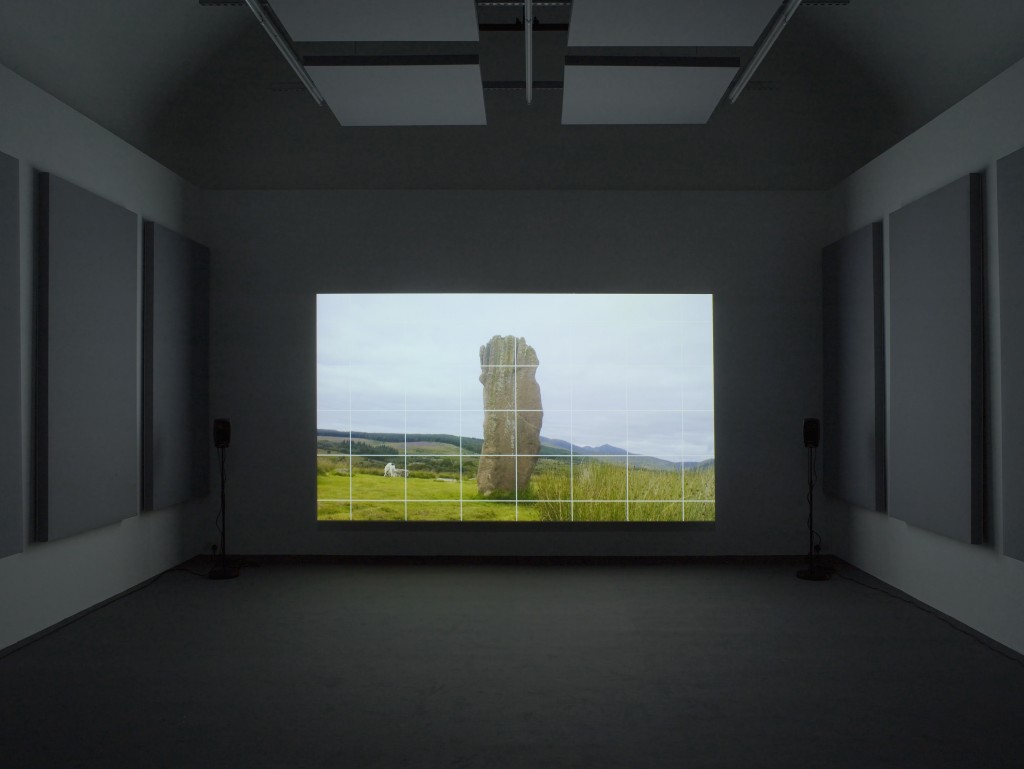
    As I edit this I am thinking back to the final scene of Turner Prize winner Chralotte Prodger’s film BRIDGIT (2016) in which a rectilinear grid is overlaid onto a shot of a neolithic stone circle. The grid expands sideways, seemingly in attempt to encapsulate the shifting networks of relations and circumstance the stones coordinate. Its columns rush past the edges of the screen into meaninglessness, and a dog runs past the stone, its lead trailing behind it.


  • How to make writing move with the object?

    How to make writing move with the object?

    This one is a little more self-reflective. It’s all I have time for and is an attempt to find a way out a problem.

    The problem is how to make writing move with my subject, which itself is unclear, and which is moving and thin: infrastructure and art. (more…)